For twenty years, the website playbook was simple: rank well, win the click. Procedure-focused and elective-focused practices in particular paid for SEO on the assumption that a higher position on a results page turned into a visit, and a visit turned into a booking. That assumption is breaking down, and it is worth being precise about how, because the true version of this story is more useful than the "SEO is dead" headline it keeps getting reduced to.
The click is disappearing, not moving somewhere else
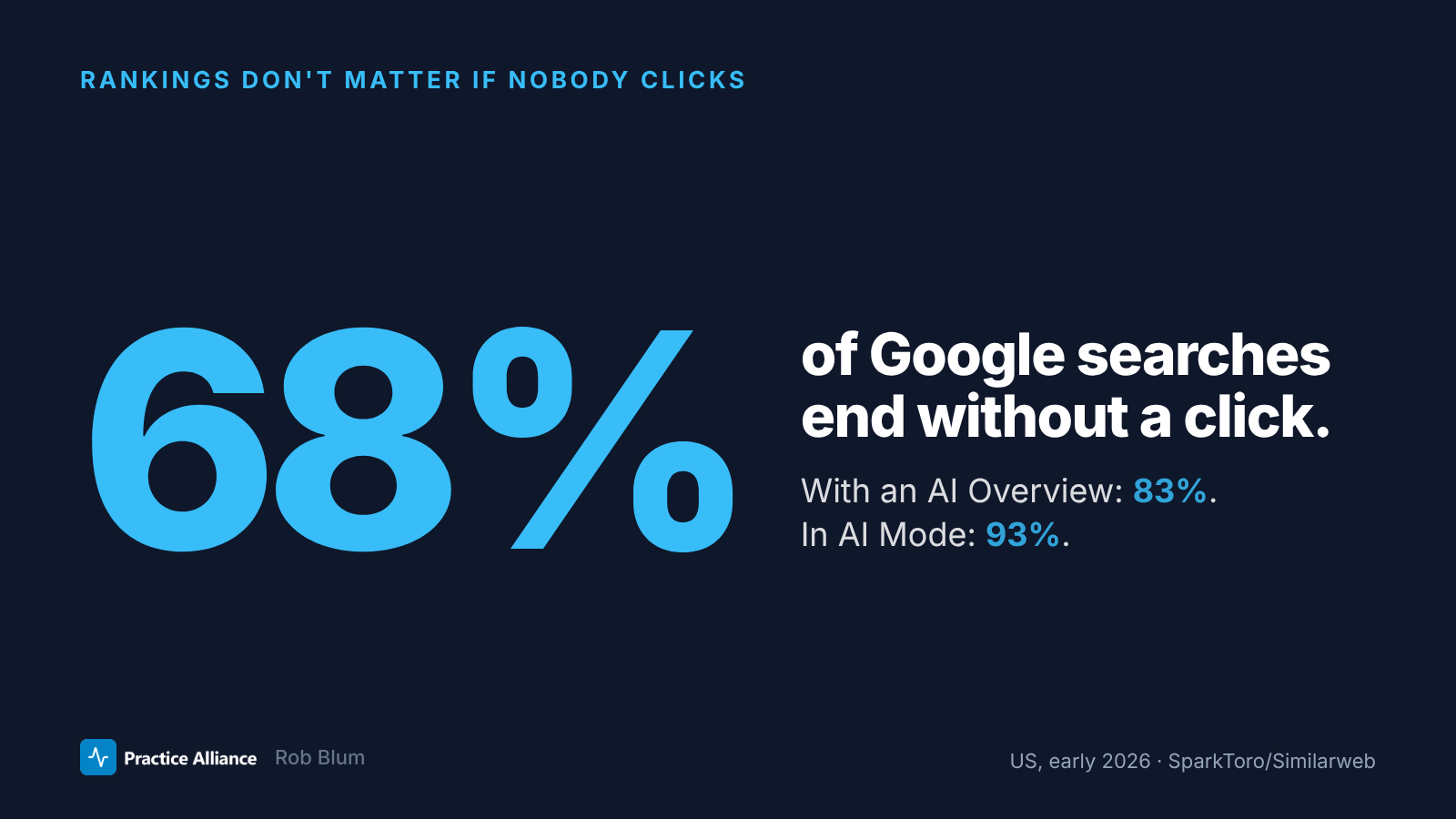
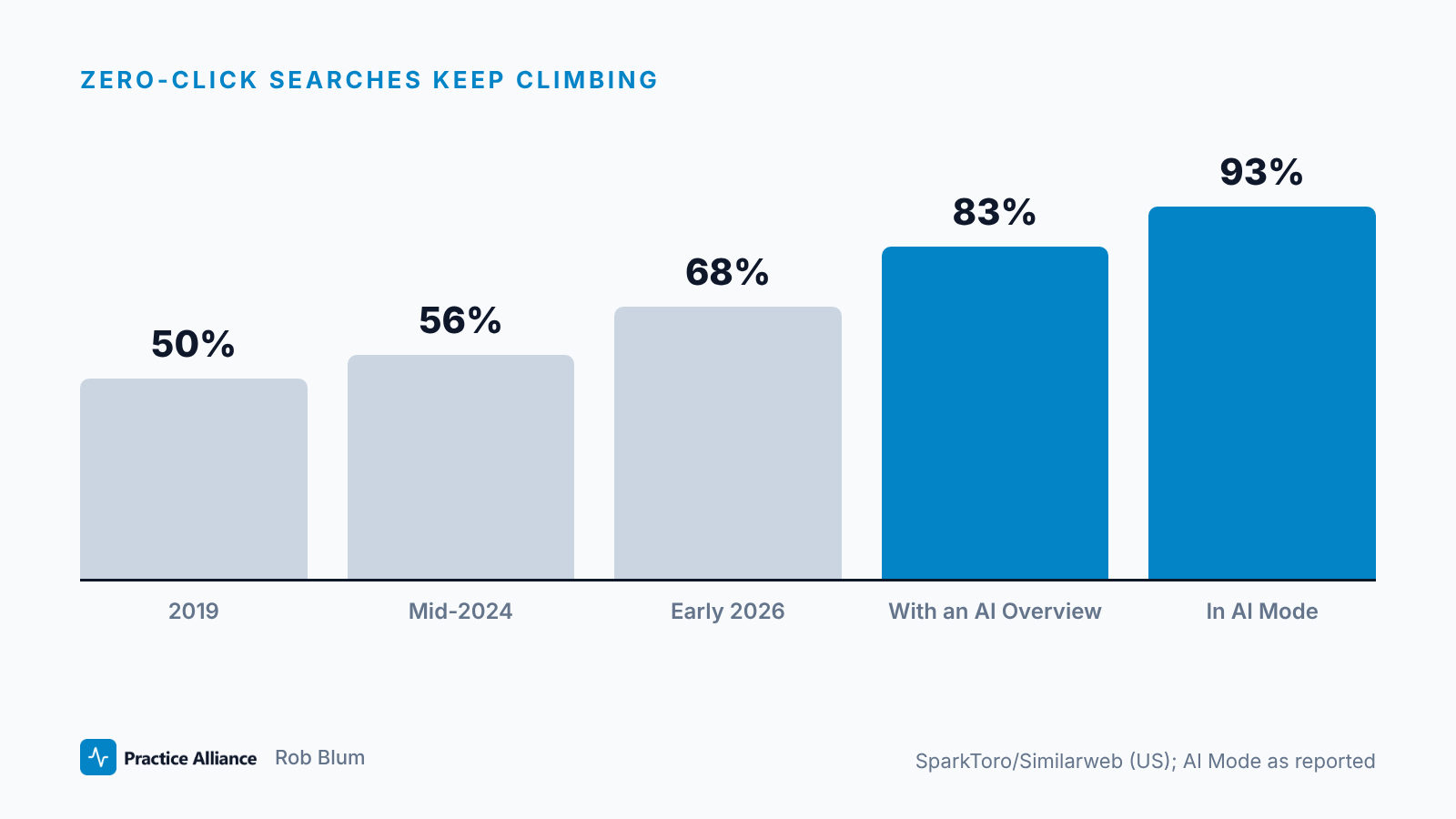
The clearest number is the zero-click rate: the share of Google searches that end without the user clicking through to any website at all. A survey by SparkToro/Similarweb put this at roughly 68% of US searches in early 2026, up from about 56% in mid-2024 and around 50% in 2019. When the result includes an AI Overview, the zero-click rate rises further, to roughly 83%. In Google's full AI Mode, it is reported as high as 93%.
Click-through rate (CTR) on the organic results that do appear tells the same story from a different angle. Seer Interactive measured organic CTR down 61% year-over-year on queries where an AI Overview shows. Ahrefs, using a different methodology, found a 58% drop specifically for the page ranking first. A randomised field experiment, the most methodologically careful study of the group, still found a 38% reduction in organic clicks on queries that triggered an overview. The exact number moves depending on who is measuring, but the direction does not.
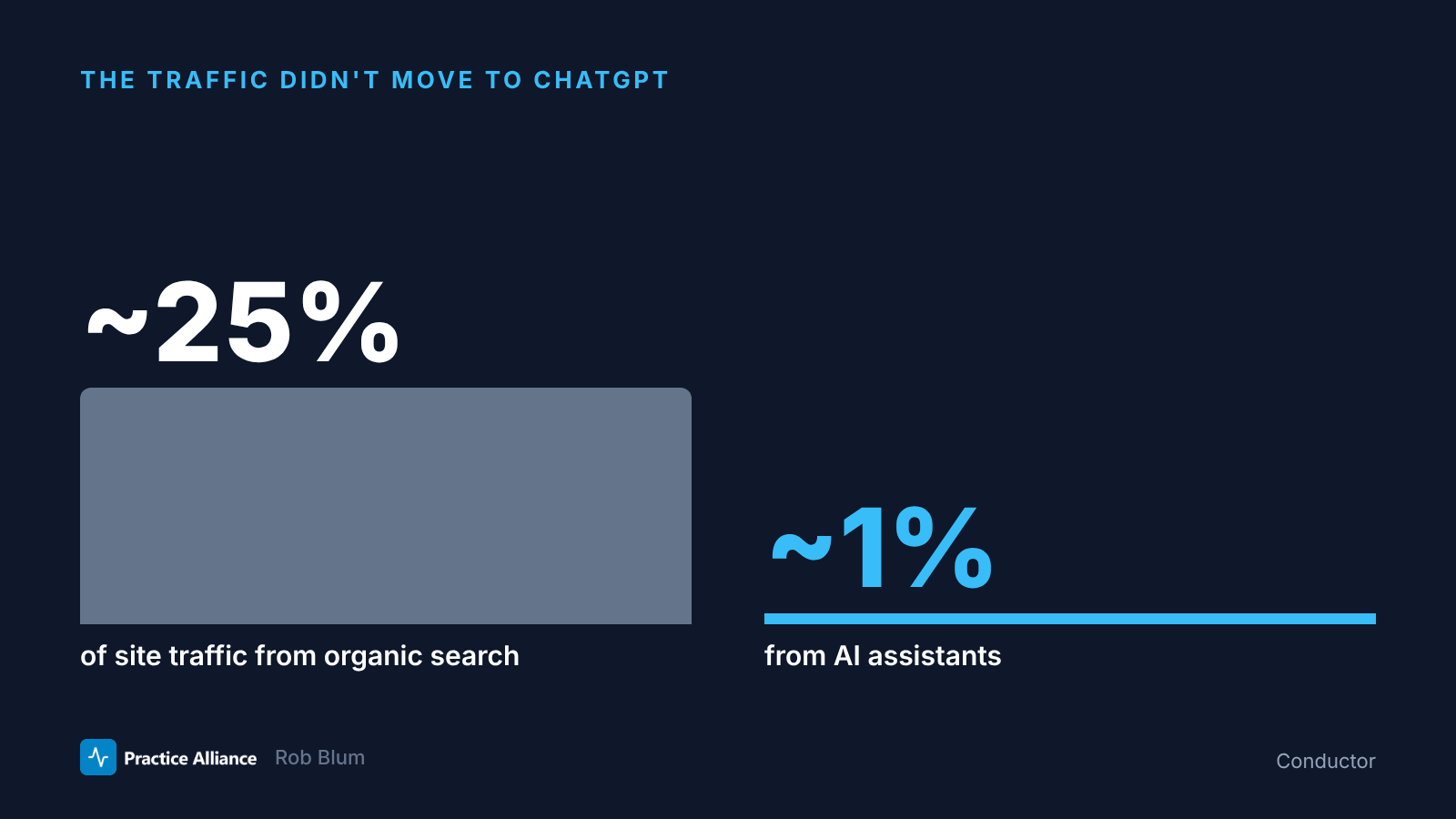
What makes this more than an SEO problem is where that lost traffic goes. It is tempting to assume it is simply moving to AI chatbots instead. It mostly is not, at least not yet. Conductor puts direct referral traffic from AI assistants at around 1% of total site traffic, against roughly 25% from organic search. Similarweb's figures are similar: 1.6% to 2.5% of traffic from AI Mode queries, versus 17% to 19% from traditional search results. The traffic is not migrating from Google to ChatGPT. It is disappearing into the answer box and not reappearing anywhere as a website visit.
A competitive handful, not one winner
The platforms sitting in that answer box are also not converging on a single winner (so far), which matters for anyone thinking about where to invest attention. Sensor Tower's most recent figures have ChatGPT's share of the AI assistant market falling below 50% for the first time in 2026, down to around 46%, with Gemini climbing to roughly 28% and Claude to about 10%. Google separately reported the Gemini app crossing 950 million monthly active users, nearly tripling in a year, largely on the back of its built-in distribution across Android and Search. Three platforms, not one, are now shaping how people find and evaluate information before they ever reach a website.
What this actually means for a specialist practice
For Australian specialist practices, none of this is really new, which is worth saying plainly. A specialist website was rarely where the real conversion happened in the first place. Referral relationships did that. GPs sent patients to specialists based on trust and track record, not search rankings.
Some elective-focused specialists still pay heavily for promoted search, but they are the exception rather than the rule. One case worth sharing: a specialist I interviewed about a year ago told me her practice was happily capturing leads through promoted search for a cost of approximately $300 per lead. I spoke with her again a few weeks ago, and that cost has nearly doubled in recent months.
The patient on the other end of that referral now arrives at the first consultation already informed, often because an AI assistant answered their preliminary questions before you ever spoke with them.
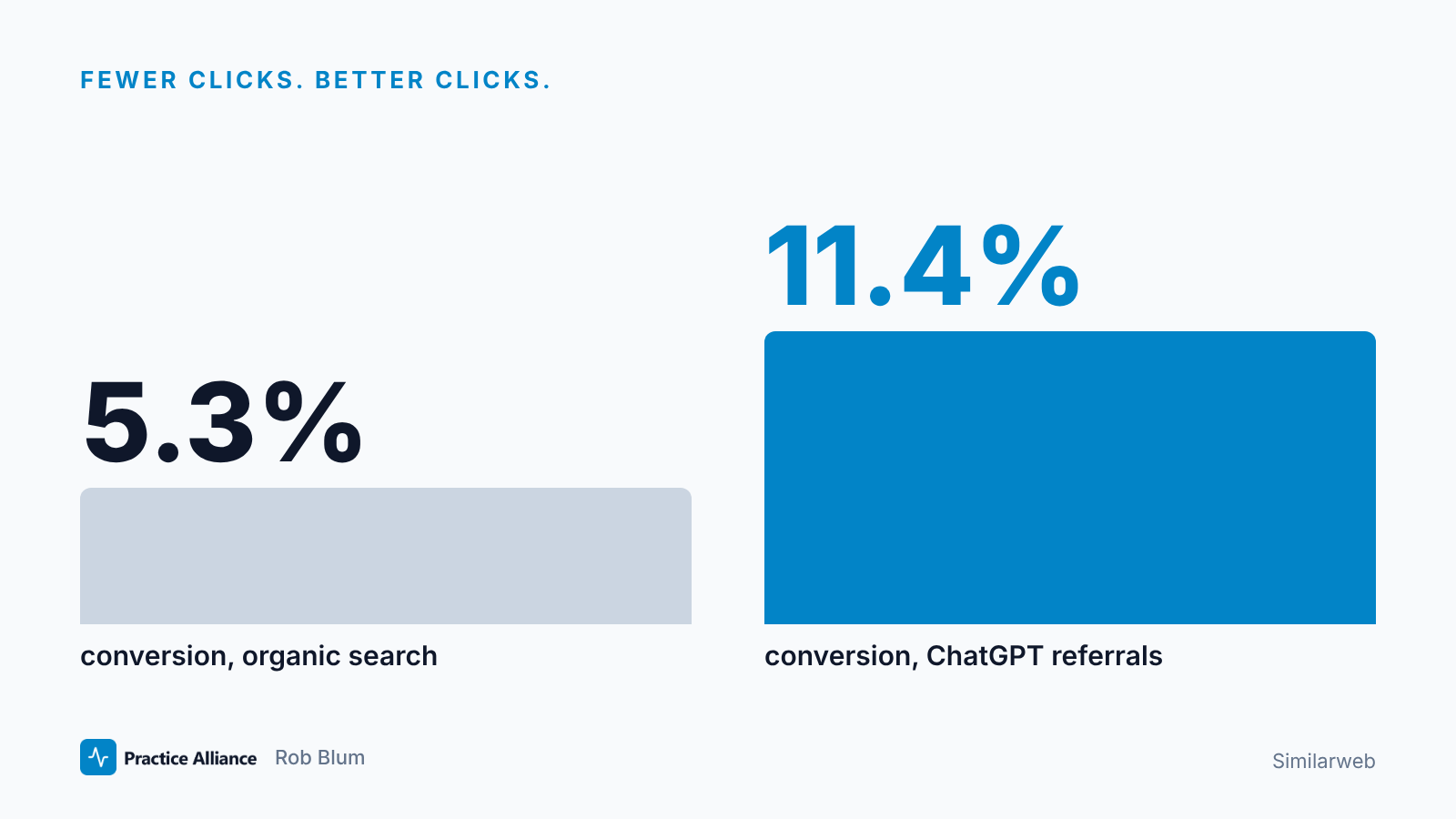
That cuts both ways, though. The traffic AI assistants do send is worth more than the traffic search used to send. Similarweb found ChatGPT referral traffic converting at 11.4%, against 5.3% for ordinary organic search, roughly double. The mechanism is straightforward: someone who reaches your site through an AI answer has usually already had the basic question resolved, so the click that remains is a more qualified one than the click SEO used to chase.
That changes what a website is actually for.
-
Chasing rankings is chasing a shrinking prize. Spending on traditional SEO to win a click that increasingly does not exist is spending against a declining asset. That does not mean a website stops mattering. It means its job changes.
-
The new job is conversion, service and communication, not ranking-driven traffic acquisition. Once a referred or AI-informed patient lands on your site, the question is whether the experience converts them into a satisfied, well-served patient, and whether it keeps your own team and your health network in sync. That is a different design brief than ranking for keywords.
-
Being legible to AI is now table stakes, not an SEO add-on. If a prospective patient asks ChatGPT or Gemini about your practice, what it tells them should be accurate, because it is drawing on the same structured data your website runs on, not guessing. Most practice websites were never built with that in mind, because the need did not exist until recently.
-
A website disconnected from your technology and service fabric is now a liability, not just a missed opportunity. When a booking request made on the site doesn't get a fast, accurate response, that is exactly where the experience breaks and high-intent patients fall through the cracks.
-
The entire health network is part of the audience, not an afterthought. A website built only for direct patient acquisition misses the relationships and trust that drive the real work in specialist medicine.
The takeaway
"SEO is dead" overstates the case. Organic search still sends real traffic, and will for some time. But the specific thing SEO was built to win, the click, is becoming the exception rather than the rule, and the traffic it used to deliver is not reappearing as AI chatbot referrals in any volume yet.
For a specialist practice, that is less of a crisis than it sounds, because the website was rarely the primary conversion channel to begin with. The landscape is changing rapidly and the approach needs to be rethought and assessed: designing a website to win rankings might become uneconomical. Providers should start thinking about their website as the conversion, service and communication layer that sits between their practice, their patients, their team and their referrer network, as a connected platform that both people and AI assistants can read accurately.
Next steps
Connect with us to learn how Practice Alliance can help your practice.