You hear it in theatre tea rooms, at practice meetings and on LinkedIn: with mortgages, groceries and insurance premiums all rising, patients are putting off elective surgery, and private lists are down 20 or 30 per cent.
It's a plausible story. Elective surgery can often be deferred, and household budgets are under real pressure. So we checked it against the national Medicare data, which records every privately billed procedure.
Myth 1: “Private surgical volumes are down 20–30%”
Verdict: Myth.
Private surgery is at a record high.
- Our index: the Practice Alliance Private Surgery Index, which tracks six high-volume procedures, reached 2,160 in September 2026, its highest level since the series began in 2005. Volume is up 1.9% on a year earlier.
- All surgery: across every private surgical operation billed to Medicare (about 12.4 million services a year), volume is up 2.8% year-on-year and 12% above pre-COVID levels.
- Anaesthesia: for the anaesthetists reading, anaesthesia services are up 2.5% on last year and 22% on 2019.
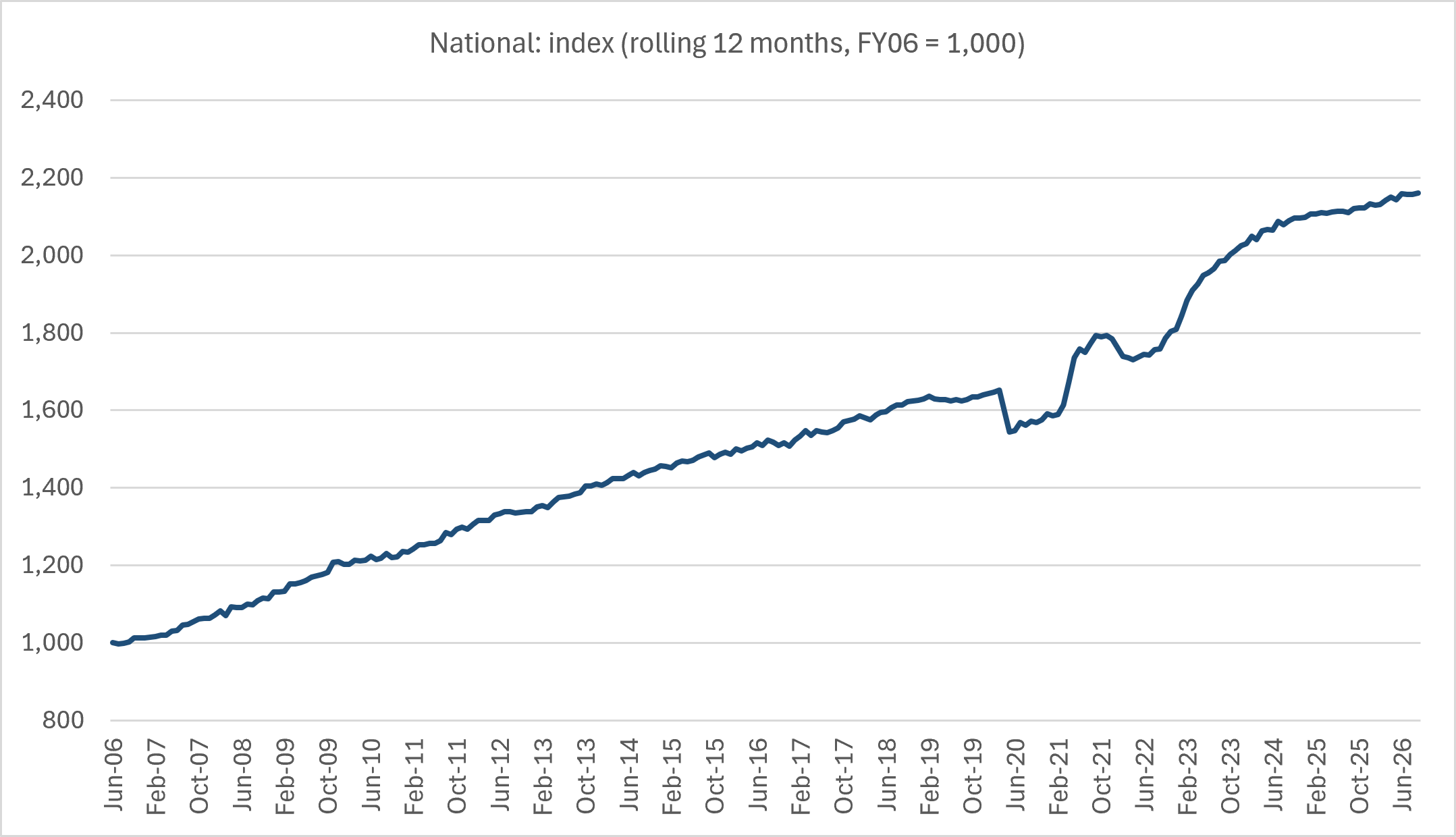
A 20–30% fall nationally would be the biggest drop in private surgery outside the April 2020 COVID shutdown. Since 2023, the worst month for all surgery was about 5% below the same month a year earlier, and that was in March 2024, which Easter timing distorts. Nothing in the data comes close to a 20% fall.
Myth 2: “Every specialty is going backwards”
Verdict: Myth.
Growth is uneven but positive almost everywhere. Year-on-year, to September 2026:
| Specialty (all private procedures) | Growth |
|---|---|
| Neurosurgery | +6.9% |
| Cardiothoracic | +5.5% |
| Colorectal / endoscopy | +5.3% |
| Plastic and reconstructive | +5.3% |
| ENT | +3.6% |
| Vascular | +3.1% |
| Ophthalmology | +2.8% |
| General surgery | +2.0% |
| Urology | +1.9% |
| Orthopaedics | +1.3% |
| Gynaecology | −1.1% |
Only gynaecology is down, and only marginally.
Truth 1: “Growth has slowed”
Verdict: True.
Volumes are at a record, but they're no longer climbing quickly.
- After COVID: the catch-up drove growth of 10–14% a year in 2021 and 2023.
- Now: growth in our index has settled at about 2%, and it has moved sideways in a narrow band since March 2026.
- Against the decade before COVID: that's below the roughly 3% a year of FY13–19.
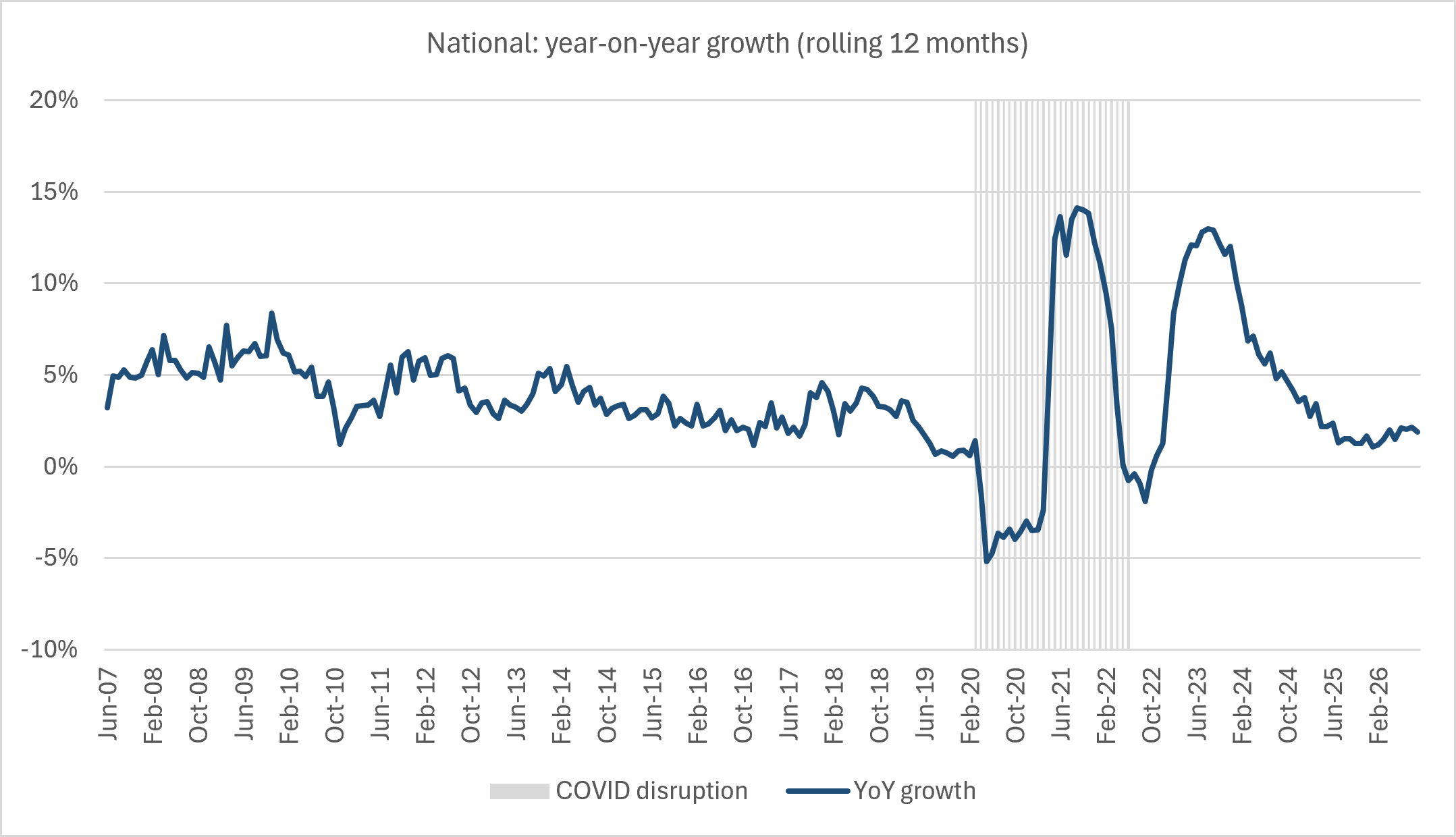
So the market is still growing, just slowly. For a practice that budgeted on 2022–24 growth rates, that can feel like a decline.
Truth 2: “Some procedures are flat”
Verdict: True, for a few big ones.
- Cataract surgery: grew only 0.5% in the last year.
- Knee replacement: grew 0.7%, and is still about 1% below its October 2024 peak.
Both procedures went through a huge post-COVID catch-up, and part of today's weakness is the hangover from that: many patients who might have had surgery in 2025–26 were treated early. Other procedures are growing faster: cholecystectomy (+4.4%), cystoscopy (+2.9%) and hip replacement (+2.5%).
So why does it feel worse than the data shows?
Several things can make a local list look much worse than the national market (our interpretation):
- The comparison point. Measured against the 2023 catch-up peak, a flat 2026 can look like a fall. Year-on-year growth in 2023 was running at 10–20% for several procedures.
- Market share. A flat market means one practice's gain is another's loss. A surgeon or hospital losing share can see a 20% drop while the market grows.
- Seasonality. January and the school holidays always dip. Compare months with the same month a year earlier, not the previous month.
- Changes to MBS item numbers. Some specialties were renumbered after recent MBS reviews. Orthopaedic and ENT item counts, for example, look 15–22% lower than in 2019 partly because new item groupings were created. Comparing old and new item numbers can exaggerate a fall.
- Patients switching to public, or delaying care. Cost-of-living pressure may be pushing some uninsured or underinsured patients to public waiting lists, which slows private growth. That shows up as slower growth, not a collapse.
What it means for practice owners
- Don't plan for a collapse, and don't plan for a boom either. About 2–3% market growth is the realistic base case for FY27.
- Check your own numbers against the market. A 2% market with your own volume down 10% points to a share or referral problem, not the economy.
- Watch the pipeline, not just the headlines. Specialist consultations, the main path into surgery, are flat. The risk is a long, slow plateau, not a sudden drop.
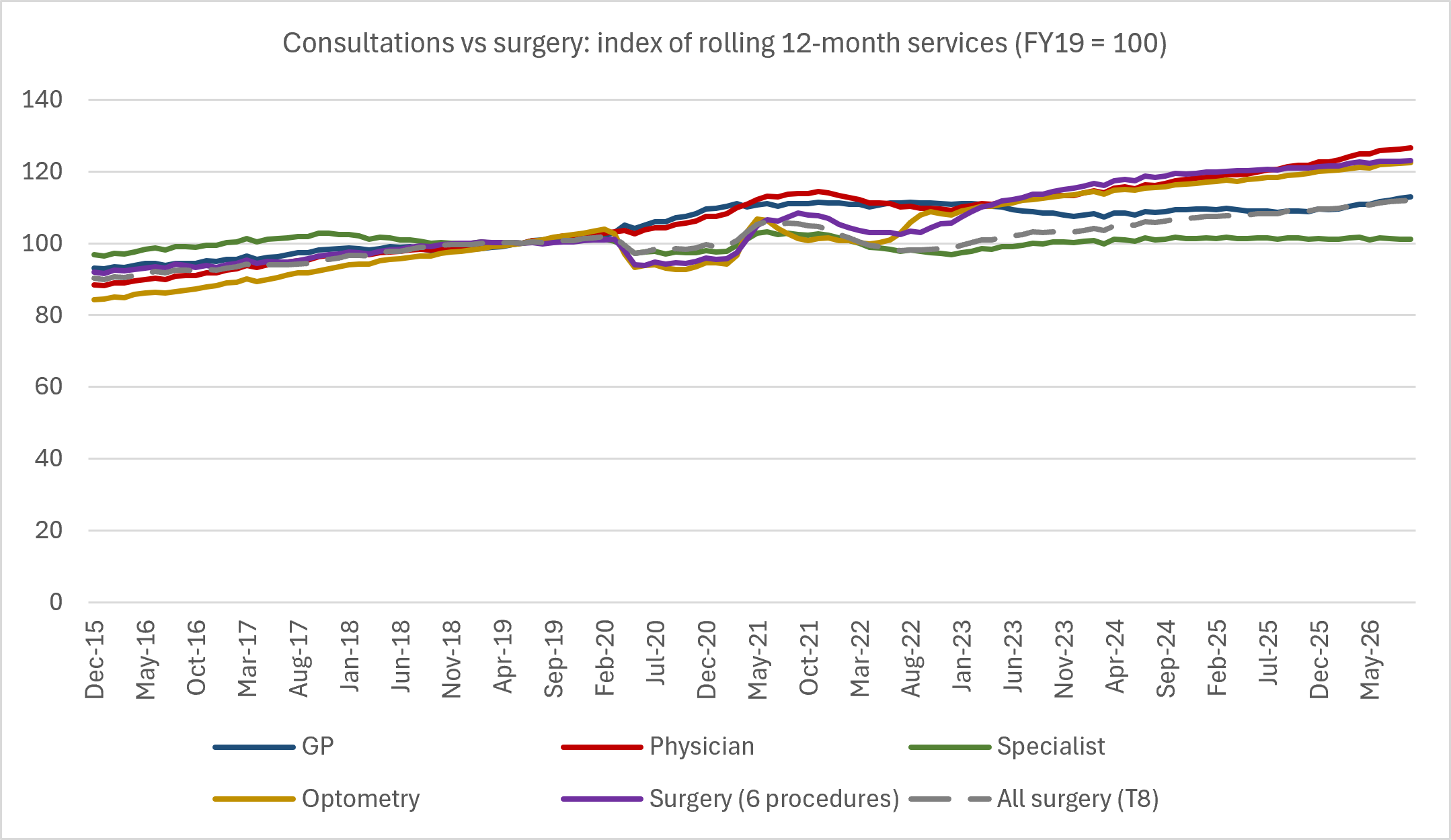
Bottom line: the cost of living is slowing private surgery's growth, but it isn't shrinking it. The 20–30% figure is a myth; the slowdown is real.
Next steps
Connect with us to learn how Practice Alliance can help your practice.
Frequently asked questions
Is private surgery in Australia declining?
No. Private surgical volume reached a record high in September 2026. Our six-procedure index was up 1.9% on a year earlier, and all privately billed surgical operations were up 2.8%.
Has the cost of living reduced elective surgery?
It may have slowed growth. Volume is still growing, at about 2–3% a year, below the pre-COVID pace of around 3%.
Which procedures are weakest?
Cataract surgery (+0.5%) and knee replacement (+0.7%) were the slowest of the six index procedures in the year to September 2026. Gynaecological procedures overall were down 1.1%.